
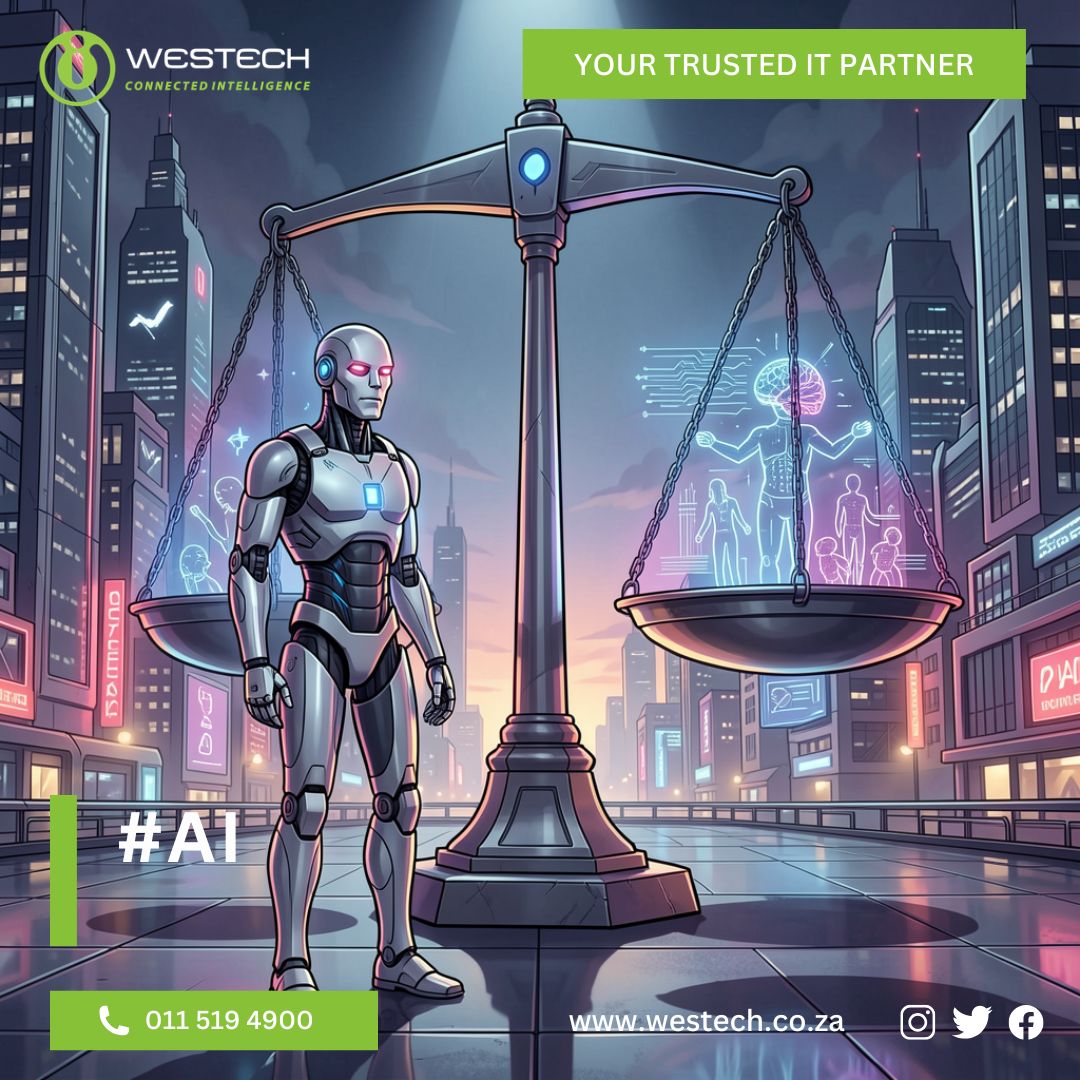
AI Hallucinations and AI Accountability Explained
Artificial intelligence has transformed how we communicate, but many users don’t realize they remain fully responsible for AI-generated content. Whether you’re using ChatGPT, Claude, Google Gemini, or Grok, AI hallucinations and formatting errors can undermine your credibility. This comprehensive FAQ explores AI accountability, explains common pitfalls like AI hallucinations, and provides actionable verification strategies. Learn how to maintain professional standards while leveraging AI tools effectively. Westech’s IT support experts can help your business implement responsible AI policies that protect your reputation and ensure compliance.
Artificial intelligence has revolutionized modern communication at unprecedented speed. From automated email responses to comprehensive reports, AI tools are embedded in virtually every digital interaction. Search engines increasingly deliver AI-generated summaries as the first response, and many users accept these answers without further investigation. Popular conversational AI platforms like ChatGPT, Grok, Claude, and Google Gemini provide seemingly limitless information with remarkable confidence.
Yet this convenience creates a dangerous assumption: that AI responsibility somehow belongs to the technology rather than the user. According to organizations using AI must establish clear accountability frameworks where someone is responsible for AI outcomes, as AI itself cannot experience consequences. Understanding AI accountability has become essential for anyone using these tools professionally.
The Convenience Trap: When Speed Trumps Accuracy
Consider a familiar scenario: you’ve drafted an email and immediately sense something is wrong. You reopen the sent message to discover an embarrassing typo, awkward phrasing, or worse – completely incorrect information. Now imagine amplifying that mistake through AI assistance.
The process seems effortless: copy your draft, ask your AI assistant to make it sound professional, wait five to ten seconds, and paste the polished result into your email. The temptation to hit send without review is overwhelming. This shortcut, however, introduces two critical vulnerabilities that many users overlook when considering responsible AI use.
The Formatting Tell: When AI Reveals Itself
The first vulnerability involves recognizable AI patterns that immediately signal minimal human oversight. AI-generated content often contains distinctive markers such as unusual formatting, specific punctuation patterns, and language choices that differ from natural human writing.
Professional communicators can identify AI-generated text through several telltale signs: the distinctive “em dash” formatting (—), unexpected indentation patterns, emoticons in formal contexts, and an overly polished tone that lacks human authenticity. When recipients detect these patterns, they recognize minimal effort was invested in personalization. This perception damages professional relationships more than the original imperfect draft would have.
The solution requires active engagement. Before sending AI-refined content, review it thoroughly for these artificial markers. Ensure the message authentically represents your voice and maintains appropriate professional standards for your relationship with the recipient. For businesses managing multiple communication channels, Westech’s IT consulting services can help establish content quality protocols.
The Accuracy Crisis: AI Hallucinations and Misinformation
The second vulnerability presents far greater risk: factual accuracy. AI hallucinations – responses containing false or misleading information presented as fact – pose significant challenges for practical deployment in high-stakes scenarios. Research indicates that AI models used in clinical decision support systems exhibit hallucination rates ranging from 8% to 20%, depending on model complexity and training data quality.
AI systems are fundamentally prone to generating plausible-sounding falsehoods. Rather than understanding truth, these systems predict statistically probable language patterns based on training data. They frequently prioritize popular opinions over factual accuracy, fabricate sources, and present speculation as verified information. While improvements continue, understanding how to verify AI output remains essential for responsible AI use.
According to when AI makes mistakes, clear governance structures must designate who oversees AI systems, who reviews decisions, and who responds when problems arise. This organizational accountability extends to individual users who must verify information before distribution.
The Harvard DCE Professional Development program emphasizes that organizations following responsible AI practices adhere to five key principles: fairness, transparency, AI accountability, privacy, and security. These principles apply equally to individual users and enterprise deployments.
For South African businesses navigating AI implementation, Westech’s managed IT services provide expert guidance on establishing verification protocols and compliance frameworks.
The Human Element: Why Shortcuts Undermine Critical Thinking
Human nature gravitates toward efficiency. We’ve become accustomed to outsourcing memory to smartphones and search engines, instantly retrieving information we once committed to recall. AI represents the next evolutionary step in this cognitive delegation.
However, this convenience creates dangerous complacency. When we fail to verify AI-generated content, we abdicate responsibility for accuracy while accepting accountability for consequences. The National Telecommunications and Information Administration emphasizes that AI accountability requires relevant actors to assure others that AI systems are trustworthy and face consequences when they’re not.
AI users hold the initial layer of accountability with responsibility to understand the functionality and potential limitations of AI tools they use, ensure appropriate use, and maintain vigilant oversight. This individual responsibility exists regardless of organizational policies or AI vendor assurances.
Consider implementing these verification strategies:
- Cross-reference factual claims with authoritative sources
- Verify statistics and data points independently
- Check that conclusions logically follow from presented evidence
- Confirm citations actually exist and support stated claims
- Review tone and formatting for authenticity
Organizations like Salesforce recommend establishing automated dashboards that flag potentially harmful or incorrect outputs, implementing fallback mechanisms for problematic responses, and conducting regular audits to assess AI accuracy over time.
Your Words, Your Responsibility: Taking Ownership of AI Outputs
Every email, document, and message bearing your name carries your professional reputation, regardless of its origin. If correspondence indicates it comes from you, you bear complete accountability for its content. This fundamental principle of professional communication doesn’t change because AI assisted in composition.
The path forward requires balanced approach: leverage AI’s efficiency while maintaining rigorous human oversight. AI can dramatically enhance productivity and refine communication, but it cannot replace critical thinking, factual verification, and authentic human judgment. For technical teams managing AI deployments, Westech’s IT security solutions help establish robust governance frameworks.
According to research from Carnegie Council for Ethics in International Affairs, the opaque nature of AI decision-making makes it difficult to trace causes of harm and hold appropriate parties accountable for system outputs. This technical limitation reinforces why human verification remains irreplaceable.
Practical Implementation: Building Your Verification Framework
Establishing personal AI responsibility protocols doesn’t require sophisticated technical infrastructure. Begin with these foundational practices:
Before using AI assistance:
- Clearly define your objective and any factual requirements
- Identify which claims must be verifiable
- your acceptable risk level for the communication
When reviewing AI output:
- Verify all factual claims against reliable sources
- Check that formatting matches your authentic style
- Ensure tone appropriately reflects your relationship with recipients
- Confirm citations and references actually exist
- Test that numerical data and statistics are accurate
Before sending:
- Read the entire message as if receiving it yourself
- Ask whether it sounds like authentic human communication
- Verify it accomplishes your intended objective
- Confirm you can defend every statement if questioned
For businesses requiring systematic approaches to responsible AI use, Westech offers comprehensive IT audits that assess current AI deployment practices and recommend improvements aligned with industry best practices.
The Bottom Line: Accountability Cannot Be Automated
As AI capabilities expand, the temptation to automate more decisions intensifies. However, AI accountability and responsibility remain fundamentally human concerns. AI systems have potential to significantly impact individuals and society, making it essential to establish clear lines of responsibility ensuring those who create and deploy AI systems are accountable for their outcomes.
The question isn’t whether to use AI – these tools offer undeniable value. The question is how to use them responsibly while maintaining professional standards and factual accuracy. Let AI enhance your capabilities but never surrender your judgment to algorithms that lack understanding, context, and accountability.
Your reputation depends on every word you send into the world. Make certain those words – AI-assisted or not – represent truth, authenticity, and the professional standards you want associated with your name.
Related Westech Resources
IT Support & Services:
- Professional IT Support – Expert guidance for technology challenges
- IT Support SLA – Service level agreements for business continuity
- Virtual IT Support – Remote assistance for distributed teams
- Managed IT Services – Comprehensive technology management
Security & Compliance:
- IT Security Solutions – Protect your digital
- IT Audit Services – Comprehensive technology assessments
Additional Resources:
- Microsoft 365 Solutions – Cloud productivity tools
- IT Outsourcing – Strategic technology partnerships
- FAQ Hub – Answers to common IT questions
Frequently Asked Questions About AI Responsibility
Is my data encrypted on these platforms?
Most major AI platforms encrypt user data while it is being transmitted and stored on their servers. However, as mentioned in the main article, encryption alone does not eliminate all AI data privacy risks. Even encrypted data may still be accessible to the platform for system improvement or moderation purposes, which is why avoiding sensitive information in prompts remains critical.
How can I use AI without risking my data safety?
The safest approach, as outlined in the article on Personal Data Safety with AI, is to use enterprise or business versions of AI platforms such as ChatGPT Enterprise or Microsoft Copilot for Business. These services typically include commercial data protection policies where prompts and documents are not used to train the model. Businesses should also implement internal AI usage policies and anonymise any data used in prompts.
What are the biggest AI data privacy risks for companies?
The most significant risk is data leakage, which occurs when sensitive information is entered into AI systems outside your organisation’s secure environment. As highlighted in the article Personal Data Safety with AI, if an employee pastes client contracts, financial records, or proprietary documents into a free AI tool, that data may be stored or used for training. This removes the organisation’s direct control over how the information is handled.
Are AI platforms like ChatGPT and Claude POPIA compliant?
As discussed in the main article, global AI platforms such as ChatGPT and Claude operate under international privacy frameworks, but using their free versions does not automatically ensure POPIA compliance for South African businesses. POPIA requires organisations to maintain strict control over personal data, and uploading client information to public AI tools can create compliance risks unless enterprise-level protections are in place.
Can free AI tools see my personal information?
Yes, in many cases they can. As explained in the article on Personal Data Safety with AI, most free AI platforms store prompts, uploads, and conversation history unless users disable these settings. This information may be reviewed by human moderators and used to improve the system’s training data. Because of this, sensitive personal or business information should never be entered into free AI tools without proper privacy controls.
AI accountability refers to the obligation of individuals and organizations to take responsibility for outcomes produced by artificial intelligence systems. Since AI cannot experience consequences, humans must remain accountable for AI-generated content and decisions. Learn more about managed IT services that include AI governance frameworks.
Learn more about this in our recent AI Accountability & AI Hallucinations FAQ Blog here.
External Authority References
For deeper understanding of AI accountability frameworks, these high-authority resources provide comprehensive guidance:
- Carnegie Council – AI Accountability – Ethical frameworks for AI responsibility (DA: 61)
- Harvard DCE – Responsible AI Principles – Five key principles for organizational AI use (DA: 84)
- NTIA – AI Accountability Policy – Federal guidance on AI trustworthiness (DA: 91)
- Salesforce – AI Accountability – Enterprise approaches to AI governance (DA: 94)
Need help implementing responsible AI practices in your organization?
Contact Westech’s expert IT team at +27 11 519 4900 or visit our contact page to discuss your technology needs.
Organizations should establish clear governance frameworks, designate AI oversight roles, implement verification protocols, provide employee training, and conduct regular audits. Contact Westech’s IT consulting team for assistance developing comprehensive responsible AI policies.
Learn more about this in our recent AI Accountability & AI Hallucinations FAQ Blog here.
External Authority References
For deeper understanding of AI accountability frameworks, these high-authority resources provide comprehensive guidance:
- Carnegie Council – AI Accountability – Ethical frameworks for AI responsibility (DA: 61)
- Harvard DCE – Responsible AI Principles – Five key principles for organizational AI use (DA: 84)
- NTIA – AI Accountability Policy – Federal guidance on AI trustworthiness (DA: 91)
- Google Cloud – AI Hallucinations – Technical explanation of AI accuracy challenges (DA: 93)
- Wikipedia – AI Hallucinations – Comprehensive overview of AI accuracy issues (DA: 95)
- MIT Sloan – AI Hallucinations Guide – Academic perspective on AI limitations (DA: 81)
- Salesforce – AI Accountability – Enterprise approaches to AI governance (DA: 94)
Need help implementing responsible AI practices in your organization?
Contact Westech’s expert IT team at +27 11 519 4900 or visit our contact page to discuss your technology needs.
Yes. Legal and professional accountability rests with the person who represents the content as their own. Courts increasingly hold professionals responsible for AI-generated mistakes, including fabricated citations and factual errors.
Learn more about this in our recent AI Accountability & AI Hallucinations FAQ Blog here.
External Authority References
For deeper understanding of AI accountability frameworks, these high-authority resources provide comprehensive guidance:
- Carnegie Council – AI Accountability – Ethical frameworks for AI responsibility (DA: 61)
- Harvard DCE – Responsible AI Principles – Five key principles for organizational AI use (DA: 84)
- NTIA – AI Accountability Policy – Federal guidance on AI trustworthiness (DA: 91)
- Google Cloud – AI Hallucinations – Technical explanation of AI accuracy challenges (DA: 93)
- Wikipedia – AI Hallucinations – Comprehensive overview of AI accuracy issues (DA: 95)
- MIT Sloan – AI Hallucinations Guide – Academic perspective on AI limitations (DA: 81)
- Salesforce – AI Accountability – Enterprise approaches to AI governance (DA: 94)
Need help implementing responsible AI practices in your organization?
Contact Westech’s expert IT team at +27 11 519 4900 or visit our contact page to discuss your technology needs.
The user who deploys or distributes AI-generated content bears primary responsibility for any errors, regardless of the AI system’s role in creation. This includes individuals, managers, and organizations that employ AI tools.
Learn more about this in our recent AI Accountability & AI Hallucinations FAQ Blog here.
External Authority References
For deeper understanding of AI accountability frameworks, these high-authority resources provide comprehensive guidance:
- Carnegie Council – AI Accountability – Ethical frameworks for AI responsibility (DA: 61)
- Harvard DCE – Responsible AI Principles – Five key principles for organizational AI use (DA: 84)
- NTIA – AI Accountability Policy – Federal guidance on AI trustworthiness (DA: 91)
- Google Cloud – AI Hallucinations – Technical explanation of AI accuracy challenges (DA: 93)
- Wikipedia – AI Hallucinations – Comprehensive overview of AI accuracy issues (DA: 95)
- MIT Sloan – AI Hallucinations Guide – Academic perspective on AI limitations (DA: 81)
- Salesforce – AI Accountability – Enterprise approaches to AI governance (DA: 94)
Need help implementing responsible AI practices in your organization?
Contact Westech’s expert IT team at +27 11 519 4900 or visit our contact page to discuss your technology needs.
Verify AI content by cross-referencing factual claims with authoritative sources, checking citations exist and support stated conclusions, confirming numerical accuracy, and ensuring logical consistency throughout the text. Westech’s IT support team can help establish verification protocols.
External Authority References
For deeper understanding of AI accountability frameworks, these high-authority resources provide comprehensive guidance:
- Carnegie Council – AI Accountability – Ethical frameworks for AI responsibility (DA: 61)
- Harvard DCE – Responsible AI Principles – Five key principles for organizational AI use (DA: 84)
- NTIA – AI Accountability Policy – Federal guidance on AI trustworthiness (DA: 91)
- Google Cloud – AI Hallucinations – Technical explanation of AI accuracy challenges (DA: 93)
- Wikipedia – AI Hallucinations – Comprehensive overview of AI accuracy issues (DA: 95)
- MIT Sloan – AI Hallucinations Guide – Academic perspective on AI limitations (DA: 81)
- Salesforce – AI Accountability – Enterprise approaches to AI governance (DA: 94)
Need help implementing responsible AI practices in your organization?
Contact Westech’s expert IT team at +27 11 519 4900 or visit our contact page to discuss your technology needs.
AI hallucinations occur when artificial intelligence generates false or misleading information presented as fact. These errors result from the AI’s pattern-matching nature rather than true understanding, making verification essential before trusting AI outputs.
External Authority References
For deeper understanding of AI accountability frameworks, these high-authority resources provide comprehensive guidance:
- Google Cloud – AI Hallucinations – Technical explanation of AI accuracy challenges (DA: 93)
- Wikipedia – AI Hallucinations – Comprehensive overview of AI accuracy issues (DA: 95)
- MIT Sloan – AI Hallucinations Guide – Academic perspective on AI limitations (DA: 81)
What is RAG? Retrieval Augmented Generation Guide
RAG (Retrieval Augmented Generation) revolutionizes how AI systems deliver accurate, up-to-date information by combining the power of large language models with external knowledge sources. Instead of relying solely on training data, RAG systems retrieve relevant information from databases, documents, and proprietary knowledge bases before generating responses. This approach dramatically reduces AI hallucinations, enables access to current information, and allows businesses to leverage AI with their specific data without expensive model retraining. Whether you’re using ChatGPT, Claude, Google Gemini, or Microsoft Copilot, understanding RAG implementation transforms how you deploy AI in customer support, internal knowledge management, and data-driven decision-making. Westech’s IT consulting experts help South African businesses implement RAG systems that deliver measurable results while maintaining data security and compliance. Read our full article here.
What is AI Coding?
AI coding tools are transforming how developers write software. Whether you are new to programming or looking to enhance your workflow, understanding AI coding fundamentals can dramatically improve your productivity. These intelligent assistants help developers write, debug, and optimize code faster than traditional methods.
Popular AI coding assistants include GitHub Copilot, ChatGPT, Claude AI, and Microsoft Copilot. These tools use advanced machine learning to understand your code context and provide intelligent suggestions. GitHub Copilot integrates directly into your editor, offering real-time code completions. ChatGPT and Claude excel at explaining complex programming concepts and helping with debugging. Microsoft Copilot provides comprehensive assistance across the Microsoft ecosystem.
Getting started with AI for beginners requires understanding both the benefits and limitations. While these tools accelerate development, they work best when you understand fundamental programming concepts. Think of them as intelligent assistants rather than replacements for learning.
If your business needs expert IT Support services or guidance implementing AI tools in your development workflow, Westech provides comprehensive Managed IT Services across South Africa.
Read the full article: AI Coding 101: Complete Beginner’s Guide
Microsoft Copilot AI Price Explained
Microsoft 365 Copilot pricing varies depending on the edition and licensing model you choose. For enterprise users, Copilot typically costs approximately $30 USD per user per month, in addition to your existing Microsoft 365 subscription. Individual users can access Copilot Pro for around $20 USD per month.
For South African organisations, pricing is subject to currency exchange rates and local licensing agreements. Windows 11 includes basic Copilot functionality at no additional cost, providing entry-level AI assistance directly within the operating system. Before budgeting, it’s important to understand how secure Microsoft Copilot is for business environments.
Additional costs may include Copilot Studio for creating custom AI agents, which operates on a usage-based pricing model. Enterprise deployments should also factor in implementation costs, user training, and ongoing support.
Not sure if Copilot is the right AI for you? See how it compares in our Copilot vs ChatGPT vs Claude comparison, explore the key features and productivity capabilities of Microsoft Copilot to assess value for money , and if you’re new to the platform, start with an overview of what Microsoft Copilot is and how it works within Microsoft 365.
Ready to explore how Copilot can benefit your organisation? Read our complete guide to Copilot AI.
Contact Westech‘s IT Support team for accurate South African pricing and licensing guidance tailored to your organisation’s specific requirements.
How Does Copilot Compare to Other AI Assistants?
Whilst ChatGPT, Claude, and Grok are powerful general-purpose AI assistants, Microsoft Copilot offers distinct advantages for organisations already using Microsoft technologies.
ChatGPT by OpenAI excels at creative writing, general problem-solving, and conversational interactions. It’s ideal for standalone tasks but requires manual data input and lacks native integration with business applications.
Claude by Anthropic specialises in handling long documents and maintaining context across complex discussions. It’s particularly strong for research and analysis tasks but operates independently from your existing software ecosystem.
Copilot‘s competitive advantage lies in its deep integration with Microsoft 365. It can directly create Word documents, Excel spreadsheets, and PowerPoint presentations within those applications, access your SharePoint files, summarise Teams meetings, and maintain context across your entire Microsoft ecosystem. For businesses already invested in Microsoft technologies, Copilot provides productivity enhancement without workflow disruption.
Not familiar with Copilot yet? Start with an overview of what Microsoft Copilot is and how businesses use it, then review Microsoft Copilot pricing and licensing considerations, understand whether Microsoft Copilot is secure and POPIA-compliant, and finally explore the key Microsoft Copilot features available within Microsoft 365 to see how it compares in real-world use.
Ready to explore how Copilot can benefit your organisation? Read our complete guide to Copilot AI,
What is Microsoft Copilot?
Microsoft Copilot is an advanced AI assistant that integrates seamlessly with your Microsoft 365 applications and Windows 11 operating system. Powered by cutting-edge GPT-5 technology, Copilot transforms how you work by understanding natural language commands and providing intelligent assistance across your entire digital workspace.
Unlike standalone AI chatbots, Microsoft Copilot works directly within Word, Excel, PowerPoint, Teams, Outlook, and other Microsoft applications. It analyses your organisational data, learns from your work patterns, and provides contextual suggestions that help you complete tasks faster and with greater accuracy.
For South African businesses, Copilot represents a practical solution for enhancing workplace productivity whilst maintaining enterprise-grade security and compliance with local regulations including POPIA.
Ready to explore how Copilot can benefit your organisation? Read our complete guide to Copilot AI
Want to understand the investment involved? See our breakdown of Microsoft Copilot pricing for South African businesses, learn whether Microsoft Copilot is secure and POPIA-compliant for business use, compare Microsoft Copilot vs ChatGPT and Claude to see how it stacks up against other AI tools, and explore what it can actually do by reviewing the key features and capabilities of Microsoft Copilot.
Is Microsoft Copilot Secure for Business Use?
Yes, Microsoft Copilot is designed with enterprise-grade security at its core. Your organisation’s data remains within your Microsoft 365 tenant and is never used to train Microsoft’s public AI models. This ensures complete data privacy and protection.
Copilot respects your existing security boundaries and permissions. Users can only access information they’re already authorised to view through their normal Microsoft 365 permissions. The AI assistant operates within your organisation’s established security policies, access controls, and compliance frameworks.
For South African organisations, Microsoft Copilot complies with the Protection of Personal Information Act (POPIA) when properly configured. Microsoft maintains comprehensive certifications including GDPR, HIPAA, ISO 27001, and SOC 2, providing assurance for regulated industries such as healthcare, finance, and legal services.
Data encryption protects information both in transit and at rest. Microsoft’s commitment to data sovereignty means South African organisations can choose data residency options that align with local regulatory requirements.
If you’re still learning the basics, start with our guide on what Microsoft Copilot is and how it integrates with Microsoft 365, then review Microsoft Copilot pricing and licensing in South Africa, compare alternatives in our Copilot vs ChatGPT vs Claude analysis, and finally explore the key features of Microsoft Copilot that support secure collaboration and data handling.
Ready to explore how Copilot can benefit your organisation? Read our complete guide to Copilot AI.
What Are the Key Features of Microsoft Copilot?
Microsoft Copilot delivers powerful capabilities across your entire Microsoft ecosystem:
Document Creation: Generate professional documents, reports, and presentations directly within Word and PowerPoint. Copilot can draft content, suggest improvements, and format documents based on your requirements.
Data Analysis: Excel integration allows Copilot to analyse datasets, create complex formulas, generate visualisations, and provide insights through natural language queries.
Meeting Intelligence: Teams integration provides real-time transcription, meeting summaries, action item tracking, and follow-up recommendations.
Email Management: Outlook assistance helps draft responses, summarise long email threads, and prioritise messages based on importance.
Custom AI Agents: Through Copilot Studio, businesses can create specialised AI agents for customer service, data entry, workflow automation, and other organisational needs.
If you’re new to the platform, begin with a clear explanation of what Microsoft Copilot is and how it works, then review how much Microsoft Copilot costs for South African organisations to understand ROI, learn whether Microsoft Copilot is safe for business use, and finally explore Microsoft Copilot vs ChatGPT and Claude to see how these features compare across AI tools.
Ready to explore how Copilot can benefit your organisation? Read our complete guide to Copilot AI
Read AI is an advanced AI meeting recording software that automatically joins video conferences to provide real-time transcription, automated meeting summaries, and intelligent note-taking. This productivity platform integrates seamlessly with Microsoft Teams, Zoom, and Google Meet, transforming how businesses in South Africa and globally document and review meetings.
Acting as your dedicated AI notetaker, the platform captures every critical detail while participants remain focused on conversations. Read AI generates comprehensive reports including action items, key questions, speaker analytics, and engagement metrics. Whether South African enterprises need reliable meeting transcription services or want to leverage AI-powered collaboration insights, Read AI delivers enterprise-grade solutions with SOC 2 certification and GDPR compliance, ensuring data security for businesses across Africa and beyond.
External Authority References
For deeper understanding of AI accountability frameworks, these high-authority resources provide comprehensive guidance:
- Carnegie Council – AI Accountability – Ethical frameworks for AI responsibility (DA: 61)
- Harvard DCE – Responsible AI Principles – Five key principles for organizational AI use (DA: 84)
- NTIA – AI Accountability Policy – Federal guidance on AI trustworthiness (DA: 91)
- Google Cloud – AI Hallucinations – Technical explanation of AI accuracy challenges (DA: 93)
- Wikipedia – AI Hallucinations – Comprehensive overview of AI accuracy issues (DA: 95)
- MIT Sloan – AI Hallucinations Guide – Academic perspective on AI limitations (DA: 81)
- Salesforce – AI Accountability – Enterprise approaches to AI governance (DA: 94)
Need help implementing responsible AI practices in your organization?
Contact Westech’s expert IT team at +27 11 519 4900 or visit our contact page to discuss your technology needs.
IT Help Is Here
Contact Westech to get support for software, hardware and other IT related products & services.
We offer in-house and outsourced IT support.
Book an IT Audit and find out how Westech can help offer you a fully managed IT solution.
In Business …
Since 1995


Related Posts


In this artilce
- AI Hallucinations and AI Accountability Explained
- The Convenience Trap: When Speed Trumps Accuracy
- The Formatting Tell: When AI Reveals Itself
- The Accuracy Crisis: AI Hallucinations and Misinformation
- The Human Element: Why Shortcuts Undermine Critical Thinking
- Your Words, Your Responsibility: Taking Ownership of AI Outputs
- Practical Implementation: Building Your Verification Framework
- The Bottom Line: Accountability Cannot Be Automated
- Related Westech Resources
- Frequently Asked Questions About AI Responsibility
- Is my data encrypted on these AI platforms?
- How can I use AI without risking my data safety?
- What are the biggest AI data privacy risks for companies?
- Are AI platforms like ChatGPT and Claude POPIA compliant?
- Can free AI tools see my personal information?
- What is AI accountability?
- How can businesses implement responsible AI policies?
- Can I be held liable for AI-generated errors?
- Who is responsible when AI makes mistakes?
- How do I verify AI-generated content?
- What are AI hallucinations?
- What is RAG? Retrieval Augmented Generation
- What is AI Coding?
- Copilot Price – How Much Does Microsoft Copilot AI Cost?
- How Does Copilot Compare to ChatGPT and Claude?
- What is Microsoft Copilot?
- Is Microsoft Copilot Secure for Business Use?
- What Are the Key Features of Microsoft Copilot?
- Read AI FAQ | Meeting Software Questions Answered
- External Authority References
Find Us on social
Recent Blog Articles


Looking for something?


IT Help Is Here
Contact Westech to get support for software, hardware and other IT related products & services.
We offer in-house and outsourced IT support.
Book an IT Audit and find out how Westech can help offer you a fully managed IT solution.
In Business …
Since 1995