
Slow and Outdated Computers
Every business has a quiet drain on its profits that rarely appears as a line item on the P&L. From an IT perspective, that drain is slow, aging, or poorly maintained computers and related infrastructure. Employees wait for applications to load, systems freeze during critical moments, helpdesk tickets pile up, and productivity quietly evaporates. Over weeks and months, those small delays turn into substantial financial losses and often hundreds of thousands of rands annually for mid-sized firms.
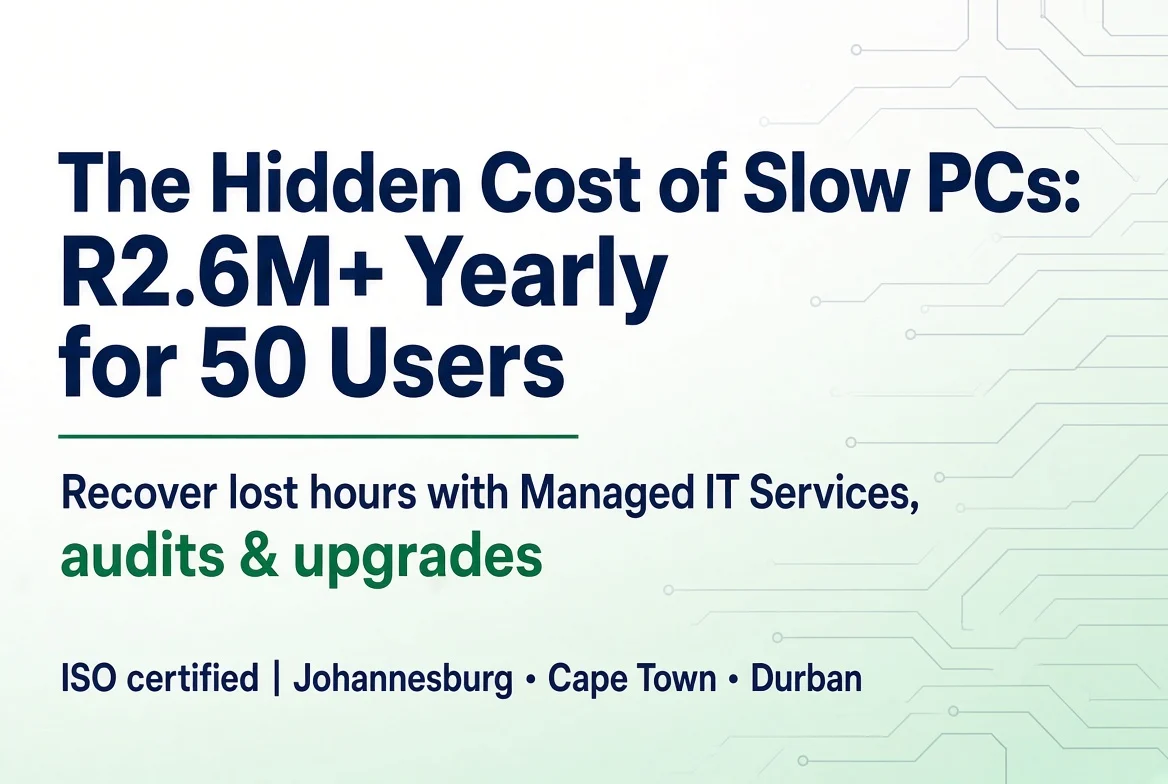
Consider a typical 50-user business. If each employee loses just 15 minutes a day to lagging machines, that equates to roughly 275 lost hours per month. At a conservative blended hourly rate of R800, the monthly productivity hit reaches about R220,00, or more than R2.6 million a year. Real-world examples from South African companies show even steeper impacts, accounting firms losing billable hours, logistics teams delayed by slow CRM systems, and call centres suffering high idle time. Add the cost of frequent support tickets, potential lost deals during demos, higher energy use from inefficient hardware, and elevated security risks from outdated systems that no longer receive patches, and the true expense becomes clear.
This waste is common because many organisations treat IT hardware as a one-time purchase rather than a performance asset. Machines older than three to four years struggle with modern software, multi-tasking, and cloud applications. Fragmented drives, insufficient RAM, spinning hard drives instead of SSDs, and neglected maintenance compound the problem. The result is frustration for staff, reactive firefighting by any internal IT resources, and a steady erosion of the bottom line.
Why This Particular Waste Matters More Than Other IT Costs
Unlike a one-off software licence or a visible server failure, slow computers create continuous, low-level friction. It reduces employee engagement, slows decision-making, and can damage client perceptions when systems lag during meetings or presentations. Outdated hardware also raises cyber risk: older devices are harder to secure and more likely to fall out of support, exposing the business to breaches that carry far higher costs than the hardware itself.
From a pure IT perspective, this is the single largest ongoing waste in many South African companies because it is both widespread and addressable. Reactive break-fix support only papers over the symptoms. What is needed is a proactive approach that restores performance, standardises the environment, and prevents recurrence.
How Westech IT Stops the Waste and Delivers Measurable Benefits
Westech (www.westech.co.za), a leading managed IT services provider in South Africa with roots dating back to 1995, specialises in eliminating exactly this kind of inefficiency. With offices supporting Johannesburg, Cape Town, Durban and beyond, ISO 9001:2015 and 27001:2022 certifications, and a strong track record of high client ratings, Westech focuses on practical, results-driven IT support, networking, maintenance, and managed services.
Key solutions Westech provides:
- Professional IT audits: A thorough assessment identifies slow devices, resource bottlenecks, outdated software, and network issues. The audit produces a clear roadmap rather than guesswork.
- Hardware optimisation and refresh programmes: Upgrades such as SSD installations, RAM increases, and targeted replacements of the worst-performing machines deliver rapid speed gains with minimal disruption. Westech supplies reliable hardware from trusted brands and handles installation and configuration.
- Proactive managed IT services and helpdesk support: Instead of waiting for tickets, systems are monitored continuously. Automated maintenance, updates, and performance tuning keep machines running optimally. Their Express Desk and mobile app enable fast remote resolution, often fixing issues in minutes without an on-site visit. Flexible Service Level Agreements (SLAs) cover on-site or remote support tailored to businesses of different sizes.
- Network, security, and connectivity improvements: Slow performance is frequently worsened by network congestion or unreliable internet. Westech designs robust networks, provides business fibre with failover, and implements cybersecurity measures (including advanced monitoring) so systems stay both fast and protected.
- Cloud and hosted services alignment: Moving appropriate workloads to well managed cloud platforms (including Microsoft 365 support as a partner) reduces local hardware strain while improving accessibility and backup reliability.
- Fixed-cost managed services options: Predictable monthly pricing replaces unpredictable repair bills and productivity losses, making budgeting straightforward.
Benefits realised by clients include:
- Dramatic reduction in “my PC is slow” tickets (examples show drops of over 90% in some cases).
- Recovery of hundreds of productive hours per month, translating directly into revenue or cost savings.
- Faster application and login times that improve staff morale and output.
- Lower long-term total cost of ownership because proactive care extends hardware life and reduces emergency spend.
- Stronger security posture and compliance readiness.
- Freed internal resources so teams can focus on core business rather than IT firefighting.
- Peace of mind from a single, accountable partner with nationwide reach and deep local experience.
Westech’s approach is systems-driven. They analyse the full environment, implement practical fixes, and then maintain performance through ongoing managed services. Clients across industries, from professional services to logistics and call centres, have reported multi-million-rand annual savings once the slow-computer tax is removed.
Contact the Westech team to see how much you can save.
Related Posts



In this artilce
Find Us on social
Recent Blog Articles

Looking for something?


IT Help Is Here
Contact Westech to get support for software, hardware and other IT related products & services.
We offer in-house and outsourced IT support.
Book an IT Audit and find out how Westech can help offer you a fully managed IT solution.
In Business …
Since 1995


